Cold Plunge Before or After Workout? What the Research Actually Says
The short answer
If you lifted heavy weights, skip the cold plunge immediately after. If you did endurance work — running, cycling, swimming — cold plunging after is fine and may help with perceived recovery. Plunging before a workout can wake you up, but do not expect it to improve your performance.
The timing question matters more than most people realize because cold water immersion does one thing to muscle recovery and a different thing to muscle adaptation. The difference is not subtle.
The big finding: CWI after strength training can blunt your gains
A 2015 study in the Journal of Physiology followed 21 men through 12 weeks of heavy resistance training. After each session, one group did 10 minutes of cold water immersion at 10°C and the other did active recovery (low-intensity cycling). The result was clear: the active recovery group gained more strength and more muscle mass.[1]
The differences were not tiny. Type II muscle fiber cross-sectional area increased by 17 percent in the active recovery group. Myonuclear addition — a marker of muscle growth — was 26 percent higher in the non-CWI group. The study authors concluded that "the common practice of cold water immersion after resistance exercise should be reconsidered."[1]
The mechanism is not fully understood, but the hypothesis is that CWI reduces the inflammatory signaling that muscles need to adapt and grow. Strength training works by damaging muscle fibers, then your body repairs them bigger and stronger. Cold water immersion appears to quiet that repair signal.
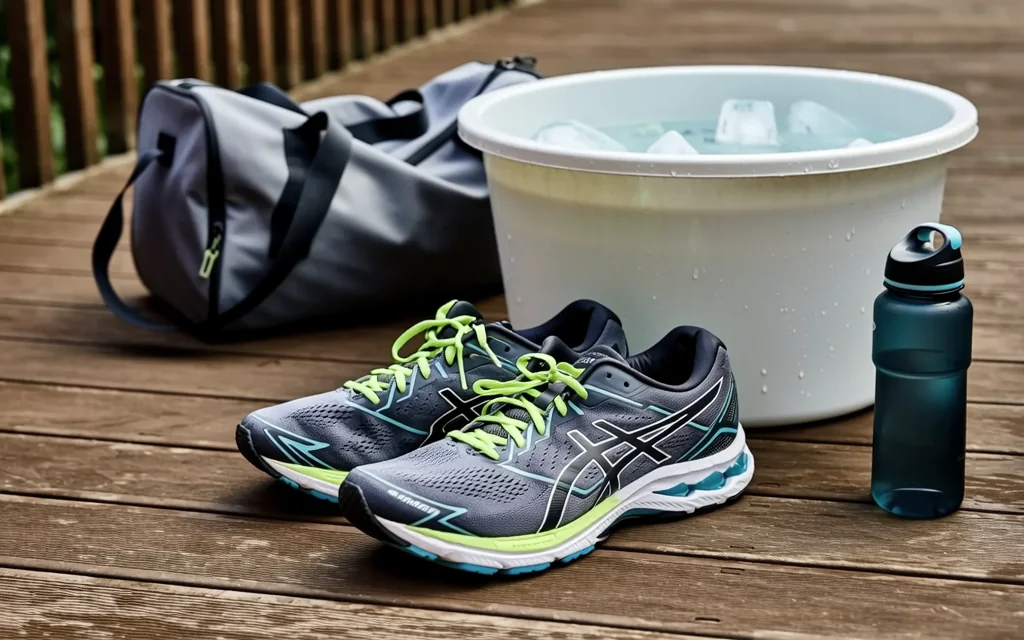
What about endurance training? Different story
A 2018 review in Sports Medicine looked at the same question and found something interesting: CWI does not appear to blunt endurance training adaptations the way it blunts strength adaptations. If anything, the cold may enhance certain endurance signaling pathways.[2]
The review covered both resistance and endurance studies and concluded that the interference effect is specific to strength and hypertrophy. For runners, cyclists, and swimmers, cold water immersion after training seems to reduce fatigue and speed up perceived recovery without compromising the training stimulus.[2]
This makes physiological sense. Endurance training relies less on inflammation-driven muscle damage than strength training does. Cooling the body and reducing inflammation after a long run does not interfere with the same adaptation pathways.
Cold plunging before a workout
What about using cold plunging as a pre-workout tool? The logic sounds good — cold exposure boosts dopamine and noradrenaline, both of which improve focus and alertness. A quick plunge before a session could, in theory, help you show up more mentally ready.
The problem is that cold water immersion also drops your core and muscle temperature significantly. Cold muscles do not perform as well. Strength output, power, and sprint speed all decrease when muscle temperature drops. You are trading mental alertness for physical performance.
A better approach: if you want the mental boost, take a cold shower (not a plunge) for 1–2 minutes before your workout, or do your cold plunge on rest days and non-training days. That way you get the neurochemical benefits without compromising your session.
The decision tree
Here is how to decide, based on what kind of training you do:
- Strength training (heavy weights, progressive overload): Avoid CWI for at least 4–6 hours after training, or better yet, plunge on a different day. Your muscles need the inflammatory signal to grow.
- Endurance training (running, cycling, swimming): CWI after training is fine. The evidence does not show the same blunting effect. It may help with perceived recovery and reduce next-day soreness.
- Mixed training (CrossFit, HIIT, sports): It depends on the session. If it was strength-dominant, treat it like strength training. If it was metabolic conditioning, treat it like endurance. Err on the side of waiting if you are not sure.
- Rest days: Plunge freely. This is the ideal time for cold exposure because you are not interfering with any post-training adaptation.
What about soreness relief?
Here is where it gets tricky. A Cochrane review of 17 trials with 366 participants found that cold water immersion did reduce delayed onset muscle soreness at 24, 48, and 72 hours after exercise compared to complete rest. So if your only concern is feeling less sore, CWI works.[3]
But the review also noted that the quality of the evidence was low and that cold water did not outperform warm water immersion or contrast baths. In other words: cold water makes you feel better, but so does warm water. The cold is not uniquely good at reducing soreness — it is just one option.[3]
The real trade-off is between short-term comfort and long-term adaptation. If you are a competitive strength athlete, feeling less sore right now is not worth sacrificing gains over months of training. If you are a recreational exerciser who just wants to feel okay tomorrow, the trade-off may be acceptable.
Practical recommendations
Based on the current research, here is a simple protocol:
- On strength days: no CWI for at least 4 hours after training. If you plunge in the morning, train in the afternoon or evening.
- On endurance days: CWI immediately after is fine. 5–10 minutes at 10–15°C.
- On rest days: plunge whenever works. This is the safest window.
- If you plunge before training: do it at least 90 minutes before, keep it short (1–2 minutes), and warm up thoroughly before your session.
You can use the free calculator on this site to get a recommended time for your water temperature and experience level.
Questions people actually ask
Will a cold plunge ruin my gains?
If you do it immediately after heavy strength training consistently for weeks, the research says yes — it can blunt strength and muscle gains. The effect is significant enough that the study authors recommended reconsidering the practice. If you wait a few hours or plunge on rest days, the impact is probably minimal.
Is it okay to cold plunge on rest days?
Yes, rest days are actually the ideal time. You get the cold exposure benefits — improved mood, metabolic adaptation, stress reduction — without any risk of interfering with post-training recovery.
Does cold plunging help with running recovery?
For endurance runners, yes. The evidence does not show the same blunting effect as with strength training. Many runners report feeling less sore and recovering faster between sessions. Just be aware that the soreness relief may be partly a placebo-like effect — cold water is not clearly better than warm water immersion for recovery.
Can I take a cold shower instead of a plunge before training?
A cold shower is a reasonable compromise if you want the mental wake-up effect before a workout. It is less intense than a full plunge, so it cools your core less. But keep it short — 1 to 2 minutes max — and warm up properly before exercising.
Keep reading
Get your number
Use the free calculator to get a safe plunge time for your water temperature and build a weekly plan that fits your goal.
Open the calculator