Cold Plunge Safety: Who Should NOT Do It and How to Stay Safe
Most people can cold plunge safely, but not all
The Harvard Health review of cold water immersion research states it plainly: cold-water immersions are generally considered safe for most people. But "most" is not "all." There are specific conditions and situations where cold plunging carries real risk.[1]
This page covers who should skip cold plunging, what can go wrong, and how to keep your sessions safe. It is the kind of information that should be more prominent in cold plunge content but often gets buried under hype.
Who should avoid cold plunging (or check with a doctor first)
Based on the Harvard Health review and established cold water safety guidelines, check with a doctor before starting if any of these apply:[1]
- Heart disease or an irregular heartbeat. Cold water causes blood vessels to constrict and heart rate to spike. For someone with underlying heart issues, this can trigger arrhythmias or cardiac events.
- High blood pressure that is not well controlled. The cold shock response temporarily raises blood pressure further, which can be dangerous if your baseline is already high.
- Diabetes, especially with neuropathy or circulation issues. Cold can impair circulation further and reduce sensation, making it harder to tell when something is wrong.
- Poor circulation or Raynaud's disease. Cold exposure can trigger severe vasoconstriction in extremities, causing pain and potential tissue damage.
- Epilepsy or a seizure disorder. Cold shock can trigger seizures in some people.
- Pregnancy. The effect of intense cold exposure on a fetus is not well studied. Most guidelines recommend avoiding it.
If you are over 60, you should also be more cautious. The cold shock response does not change with age, but the cardiovascular system becomes less resilient. Start warmer and shorter than you think you need to.
The real risks of cold water immersion
Understanding the actual risks helps you avoid them. The drowning physiology literature identifies four distinct risk pathways in cold water:[2]
- Cold shock: The immediate response to cold water — gasping, hyperventilation, heart rate spike — that can cause you to inhale water or trigger a cardiac event. This is the highest-risk phase, lasting 1–3 minutes.
- Cold-induced incapacitation: As your muscles and nerves cool, you lose coordination and strength. Your hands stop working properly. Grip strength drops significantly within minutes in cold water.
- After-drop: After you get out, your core temperature can continue to fall for 20–30 minutes as cold blood from your extremities circulates back to your core. This is why you need to warm up actively after a session.
- Hypothermia: In prolonged immersion, your core temperature drops below 35°C. The risk increases with colder water, longer sessions, and smaller body size.
Safety rules that actually matter
- Never hold your breath in cold water. The gasp reflex is real. If you hold your breath and then gasp involuntarily, you can inhale water. Keep breathing, even if it is shallow.
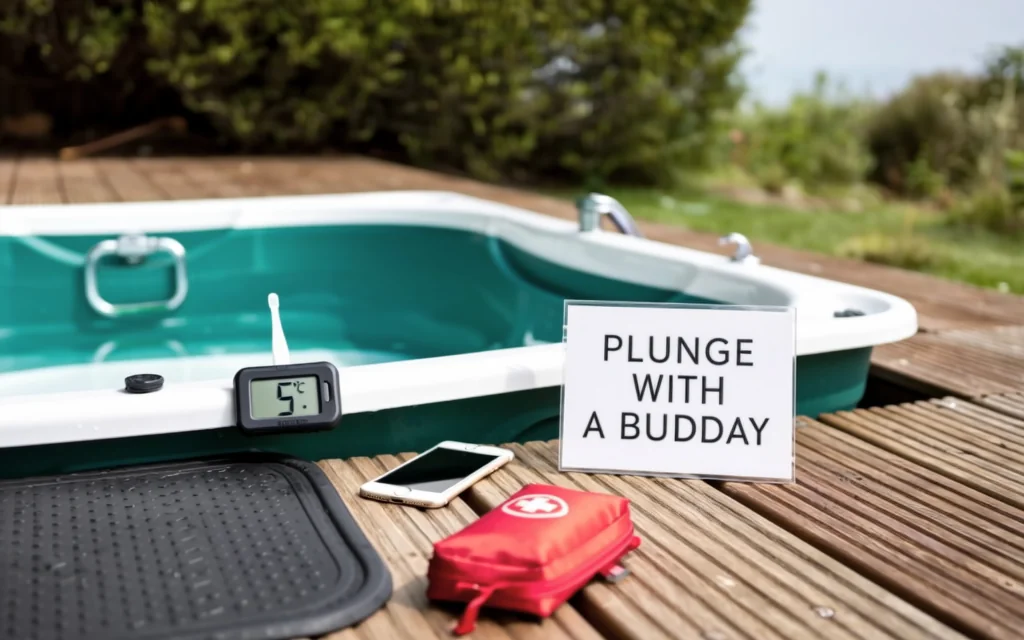
- Know your water temperature. A difference of 2°C changes your safe time window significantly. Use a thermometer, not your hand.
- Have a towel and warm clothes within arm's reach. The after-drop hits hardest in the first 10 minutes after you get out. Do not have to search for a towel while shivering.
- Plunge with a buddy if possible. If you plunge alone — which most people do — start more conservatively. There is no one to help if you get into trouble.
- Get out if you feel dizzy, cannot control your breathing, or start shivering violently. Those are warning signs, not challenges to push through.
The honest bottom line
Cold plunging is a low-risk activity for most healthy adults who practice common sense. The danger comes from three things: pre-existing conditions that interact badly with cold, ego-driven sessions where you stay too long or go too cold, and plunging alone in unsafe conditions.
Use the free calculator on this site to get a safe starting time for your water temperature. It factors in your health profile and gives you a conservative time.
Questions people actually ask
Can cold plunging cause a heart attack?
In someone with undiagnosed or poorly controlled heart disease, yes. The cold shock response increases heart rate and blood pressure acutely. This is why anyone with a heart condition should check with a doctor before starting. For a healthy person, the risk is extremely low.
Is it safe to cold plunge alone?
It is safer with someone else present, but most people do it alone at home. If you plunge alone, start with warmer water and shorter times, and always have a phone nearby. The risk of incapacitation or after-drop is manageable with conservative protocols.
What is the after-drop and why does it matter?
After-drop is the continued drop in core body temperature after you exit the cold water. Your extremities are cold, and as they rewarm, that cold blood flows back to your core. This can lower your core temperature further for 20–30 minutes after you get out. This is why active warm-up — walking, moving, dressing warmly — is important post-plunge.
Can you drown from cold plunging?
In extreme cases, yes. The drowning physiology literature identifies cold shock and cold-induced incapacitation as direct precursors to drowning. This is most relevant in open water, where waves and depth add additional risk. In a controlled home setup with manageable water depth, the drowning risk is much lower but not zero.
Keep reading
Get your number
Use the free calculator to get a safe plunge time for your water temperature and build a weekly plan that fits your goal.
Open the calculator