Cold Plunge vs Cold Shower: Which Is Actually Better?
They are not the same thing
People use the terms cold plunge and cold shower interchangeably, but they produce very different physiological responses. A cold shower hits your upper body and back with a stream of water. A cold plunge submerges your entire body up to the neck. That difference in coverage creates a difference in the cold shock response that is big enough to matter.
Here is the honest comparison: cold showers are more convenient and easier to start. Cold plunges are more effective at triggering the physiological response. Which one you should do depends on what you are trying to achieve and what you can sustain.
The coverage problem
The biggest difference between a cold shower and a cold plunge is how much of your body is exposed to cold at once.
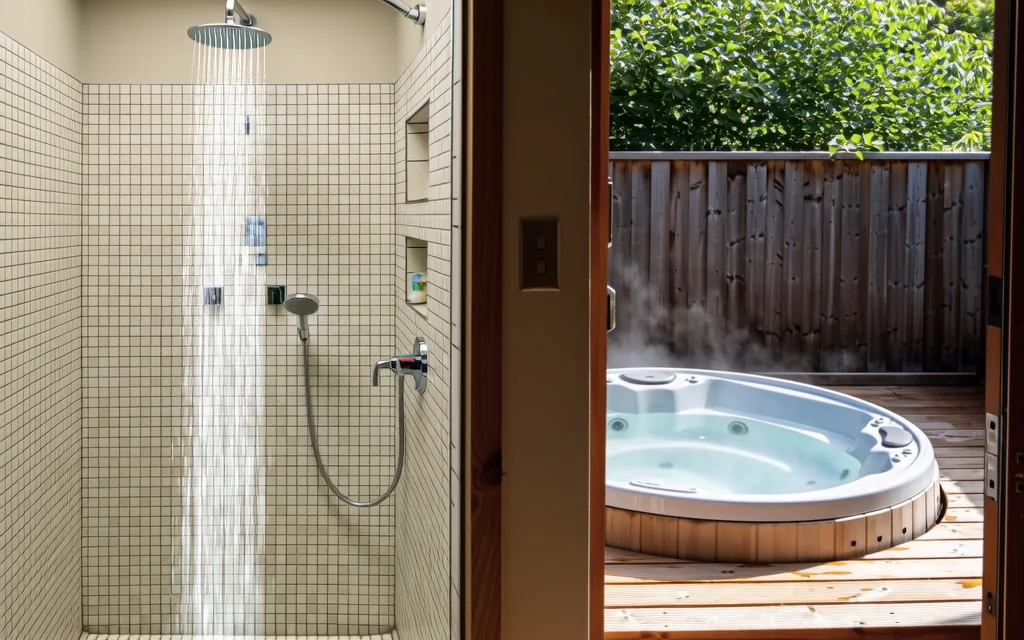
- Cold shower: Water hits your head, shoulders, and back. Your arms and legs are partially exposed. Your core — the area most relevant for thermoregulation — gets some exposure but not full immersion. The water runs off, so the cooling effect is convective (moving water) rather than conductive (still water surrounding you).
- Cold plunge: Your entire torso, arms, and legs are submerged. Water surrounds you on all sides. There is no "warm pocket" where water is running off. The cooling effect is uniform and complete. Your body has to work much harder to maintain core temperature.
This difference in coverage means the cold shock response is significantly stronger in a plunge. The dopamine and norepinephrine release is larger. The activation of brown fat is more complete. The calorie burn is higher.
Temperature differences matter
A cold shower is typically around 10–15°C (50–59°F) coming out of the tap in cold climates, but the water that actually hits your body is a mix — you move around, parts of you are not under the stream, and the water warms slightly as it runs over your skin.
A cold plunge is a controlled temperature. You know exactly how cold the water is because you set it or measure it. The PLOS 2025 meta-analysis found that the research on cold water immersion used temperatures from 7°C to 15°C with the subject fully immersed.[1]
You can make a cold shower colder by letting it run longer, but you cannot make a shower as effective as a plunge at the same temperature, because the coverage is different.
Convenience and sustainability
Here is where the cold shower has a real advantage: it costs nothing extra. You already have a shower. You turn the dial to cold and you are done. A cold plunge requires a tub, a tank, or some other container, plus water management.
The research on habit formation is clear: the easier something is to do, the more likely you are to stick with it. If a cold shower is the difference between doing cold exposure and not doing it, do the cold shower. A cold shower you actually take is better than a cold plunge you think about but never set up.
What you get from each
- Cold shower: Milder cold shock response. Some dopamine/norepinephrine release but at lower levels. Easier to control breathing. Lower risk of overdoing it. Good for building the habit of cold exposure. Can be done anywhere, anytime.
- Cold plunge: Full cold shock response. Stronger neurotransmitter release. Better brown fat activation. Higher calorie burn. More metabolic adaptation. More risk if you push too far. Requires equipment and space.
The Harvard Health review of cold water immersion notes that the evidence for health benefits — stress reduction, improved sleep — comes mainly from studies of immersion, not showers, because immersion triggers a stronger physiological response.[2]
How to decide
Here is a simple decision tree:
- If you have never done cold exposure before: start with cold showers for 2 weeks. 30 seconds at the end of your normal shower, work up to 2 minutes. This builds the mental habit without the intensity of a plunge.
- If you want maximum physiological effect: go with a cold plunge. You do not need an expensive setup. A stock tank or even a large plastic storage bin works.
- If you travel frequently: cold showers are your fallback. A 2-minute cold shower in a hotel is not the same as a plunge, but it maintains the habit.
- If you cannot decide: do both. Start your day with a cold shower on non-plunge days, and do a plunge when you have time and setup ready.
Questions people actually ask
Is a cold shower as good as a cold plunge?
No, not for the same physiological response. A cold shower produces a milder version of the same effects. It is better than nothing, but a plunge triggers a stronger cold shock response, larger neurotransmitter release, and more effective brown fat activation.
How long should a cold shower be?
For a cold shower, 1–3 minutes is the effective range. Longer than that gives diminishing returns. The goal is to stay under the cold stream without moving out of it. Rotating to keep the water hitting different areas helps maximize coverage.
Is it easier to start with cold showers?
Yes. Cold showers are less intense and require no special equipment. The mental barrier is lower. Starting with 30 seconds of cold at the end of your normal shower is a low-risk way to build the habit. You can switch to plunging later if you want more effect.
Can I get the mental health benefits from cold showers alone?
You can get some benefit, but the effect is milder. The stress reduction and mood effects reported in the research are based mainly on immersion studies. Cold showers may produce enough of a response to notice, but if you are specifically seeking the mental health effects, a plunge is more reliable.
Get your number
Use the free calculator to get a safe plunge time for your water temperature and build a weekly plan that fits your goal.
Open the calculator