How Cold Should a Cold Plunge Be? A Practical Temperature Guide
The short answer
The sweet spot for most people is 10°C to 15°C (50°F to 59°F). Stay in that band and you will get a real cold response without the kind of intensity that makes the first minute feel like a panic attack. Colder than that and your time window shrinks fast. Warmer than that and you are basically taking a cool bath — pleasant, but not doing much for cold adaptation.
A 2025 meta-analysis that combined data from 11 studies and 3,177 people found that the cold-water immersion protocols researchers actually use fall almost entirely in this range — 7°C to 15°C, with most sessions between 30 seconds and 15 minutes.[2], [3]
So if you are setting up at home and wondering what temperature to aim for: 12°C is a solid starting target. Not so cold that you dread it, cold enough that your body has to work.
Where the "10 to 15" range comes from
This is not some wellness influencer picking a number out of thin air. The 10–15°C band appears consistently in peer-reviewed research on cold-water immersion. The PLOS One meta-analysis included studies where water temperatures ranged from 7°C to 15°C. The Harvard Health review of that same research describes water temperatures of 45°F to 59°F — which is 7°C to 15°C.[2], [3]
Dr. Susanna Søberg's research on winter swimmers — the same work that produced the "11 minutes per week" observation — studied people who plunge in natural waters that can range from near-freezing up to about 15°C depending on the season. Her work focuses on how the body adapts to repeated cold exposure, and the temperatures her subjects experienced fall squarely in this band.[1]
What happens at different temperatures
Temperature changes what your body does during immersion. Here is the rough breakdown by zone:
- Above 18°C (64°F): Basically a cool bath. You will feel refreshed but your body does not mount a significant cold-stress response. Good for cooling down after a hot day, not great for cold adaptation. Most studies do not even consider this "cold water immersion."
- 15–18°C (59–64°F): The entry zone. You will feel the cold, especially in your hands and feet, but the shock response is mild. Useful for beginners who find 10°C too intense. A good transitional temperature.
- 10–15°C (50–59°F): The therapeutic sweet spot. Your breathing changes, your heart rate adjusts, and you get a strong hormonal response. This is where most research and most regular plungers operate.
- 7–10°C (45–50°F): The advanced zone. The cold shock response is significant. Sessions need to be short — 1 to 3 minutes for most people. This range is common in commercial cold plunge setups.
- Below 7°C (45°F): Extreme. Only for experienced cold-water swimmers who have built up tolerance over months or years. The risk of cold shock, incapacitation, and hypothermia climbs fast. Even seasoned winter swimmers limit time in this range.
These temperature zones are general guides, not prescriptions. Your personal tolerance depends on body composition, your environment (air temperature, wind), and whether you are adapted or not.
Temperature by goal
The best temperature also depends on what you are trying to achieve:
- For cold adaptation and metabolism: 10–15°C. This is where brown fat activation and cold-induced thermogenesis kicks in. Søberg's research on winter swimmers showed that repeated exposure in this temperature range produces measurable metabolic adaptations over time.
- For post-exercise recovery: 10–15°C, but on the cooler end (10–12°C). The Cochrane review found that CWI reduced muscle soreness, but the studies generally used colder temperatures within this range. Worth noting again: recovery benefit comes at the cost of potentially blunting strength gains if you plunge immediately after heavy lifting.
- For mental alertness and mood: 10–15°C. You do not need extreme cold to get the dopamine and noradrenaline spike. The shock of entering 12°C water is enough to trigger the response.
- For general stress reduction: 12–15°C, where you can stay longer without the intensity overwhelming you. The PLOS 2025 data suggests stress reduction was clearest about 12 hours after moderate-temperature immersion.
Note that these overlap a lot. The 10–15°C range covers most goals. The main difference is where you land within that band and how long you stay.[2], [3]
Why colder is not automatically better
There is a persistent idea in cold plunge circles that colder is always better — that if 10°C is good, 5°C must be twice as good. The research does not support this. The PLOS meta-analysis found benefits across a range of temperatures, and there was no clear dose-response relationship showing that colder water produced more benefits.
What colder water definitely does produce is more risk. Below 10°C, the cold shock response intensifies significantly. Below 7°C, the drowning review literature identifies cold shock and physical incapacitation as real concerns, especially for solo plungers. The window between "effective" and "dangerous" narrows fast as the temperature drops.[4]
How to measure and check your water temperature
Accurate temperature matters more than you think. A difference of 2–3°C can be the difference between a manageable session and a genuinely dangerous one. Here is the practical side:
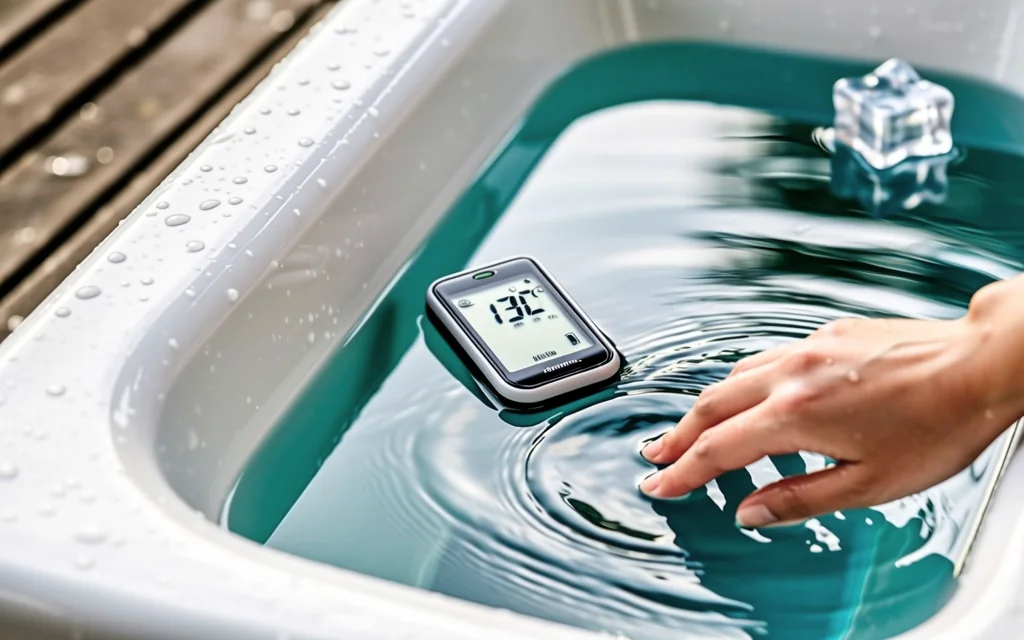
- Use a digital thermometer, not your hand. Your hands are terrible temperature sensors in cold water — they go numb quickly and will tell you the water is colder than it really is. A simple kitchen thermometer with a probe works fine.
- Check temperature at multiple spots in your tub or tank. Water can stratify — warmer at the top, colder at the bottom — especially if you add ice. Stir before you get in.
- For ice baths: the amount of ice needed depends on starting water temperature and volume. In general, adding about 1 kg of ice per 10 liters of water will drop the temperature by roughly 5–7°C depending on conditions.
- For commercial cold plunge units: set the chiller to your target and wait for the water to stabilize before getting in. Some units fluctuate by a degree or two as the compressor cycles.
The point is: do not guess. Knowing your exact water temperature is the single most important safety measure you can take, and it is the one piece of information that lets you track your progress accurately.
A practical starting temperature
If you are new to cold plunging, do not start in the deep end:
- Week 1–2: 14–15°C (57–59°F) for 1 minute. This will feel cold but manageable. Focus entirely on breathing.
- Week 3–4: 12–13°C (54–55°F) for 1–2 minutes. Your breathing should settle faster now.
- Week 5–6: 10–12°C (50–54°F) for 2–3 minutes. This is the sweet spot most regular plungers operate in.
- Beyond: If you want to go colder, drop by 1°C at a time and shorten your duration accordingly. The colder you go, the shorter you stay.
You can use the free calculator on this site to get a recommended time for your specific water temperature and experience level.
Questions people actually ask
Is 15°C (59°F) cold enough for a cold plunge?
Yes. 15°C is at the warm end of the therapeutic range, but it is cold enough to trigger a cold response, especially if you are a beginner. As you adapt, you will likely want to move toward 12–13°C, but 15°C is a perfectly valid starting point. Many commercial cold plunge programs operate at 15°C.
What happens if the water is too cold?
Below 7–10°C, the cold shock response becomes strong enough that your breathing becomes hard to control, your heart rate spikes, and your coordination starts to go. These are the exact conditions that increase drowning risk, according to the physiology of drowning research. If you cannot control your breathing within the first 30 seconds, the water is too cold for your current level.
Do I need ice for an effective cold plunge?
Not necessarily. Ice is useful if your tap water or ambient temperature cannot get below 15°C, but many people get effective sessions at 12–15°C without ice. A chest freezer conversion or a chiller unit gives you precise control without buying bags of ice. Ice is mostly about temperature control, not about the visual of floating ice cubes.
Should I measure water temperature every time?
Yes. Water temperature changes with ambient temperature, ice melt, and how many sessions you have done. A session that felt fine at 12°C yesterday could be dangerously cold at 8°C today if conditions changed. A $10 digital thermometer removes all the guesswork.
Keep reading
Get your number
Use the free calculator to get a safe plunge time for your water temperature and build a weekly plan that fits your goal.
Open the calculator