How to Build a Cold Plunge Routine That Actually Sticks
The real problem is not the cold — it is the routine
Most people who try cold plunging quit within the first two weeks. Not because the cold is too intense — most people can handle 30 seconds of cold water. They quit because they did not build a system for doing it consistently.
Cold plunging is a habit like any other. The research on habit formation says that consistency beats intensity, environment matters more than willpower, and the first few repetitions determine whether a behavior sticks. This guide applies those principles to cold plunging specifically.
Start smaller than you think you need to
The #1 mistake in building a cold plunge habit is starting too hard. You see people online doing 5 minutes in 4°C water and think that is the target. It is not. The target is whatever makes you want to do it again tomorrow.
- Temperature: Start at 14–15°C (57–59°F). This is cold enough to feel like something but warm enough that you do not dread it.
- Duration: Start at 30–60 seconds. Not 5 minutes. Thirty seconds. The goal is to build the habit, not to test your limits.
- Frequency: 3 times per week. Every other day. This gives your body recovery time and leaves room for life to happen without breaking the streak.
Use the habit stacking method
Habit stacking means attaching a new habit to an existing one. Instead of "I will cold plunge today," which depends on motivation, use: "After I [existing habit], I will cold plunge."
Examples that work:
- "After I pour my morning coffee, I will cold plunge." The coffee is the trigger. Plunging before coffee also means the dopamine from the plunge makes the coffee hit differently.
- "After I finish my workout, I will cold plunge." Works best for endurance training. For strength training, wait a few hours.
- "After I brush my teeth in the morning, I will cold plunge." The bathroom is already where you get wet. The transition is seamless.
The key is to be specific. "I will plunge after my coffee" is a stack. "I will plunge sometime in the morning" is not.
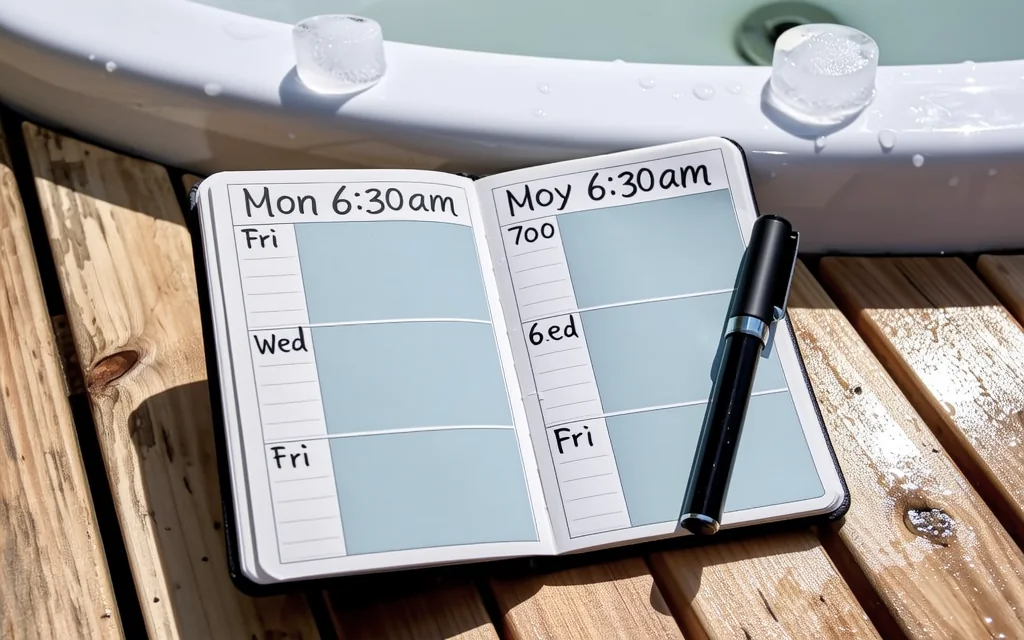
Reduce friction
Friction is anything that makes a behavior harder to do. Every extra step between you and the cold water is a reason to skip. Here is how to reduce it:
- Prep your setup the night before. Fill the tub, check the temperature, have the towel out. In the morning, the only decision is getting in.
- Set a timer. Do not watch the clock. A 60-second timer removes the "is it long enough yet?" mental negotiation.
- Keep a log. Track your sessions — date, temperature, duration, how you felt. The tracker on this site handles this for you.
What to do when you do not want to do it
Motivation will fade. Here is how to handle it when it does:
- The two-minute rule: Tell yourself you only have to get in for 30 seconds. If you want to get out after that, you can. Most people stay longer once they are in. The barrier is starting, not continuing.
- The "never skip twice" rule: You will miss a session. Life happens. The rule is: never miss two in a row. One missed session is a break. Two is a pattern.
- The habit is the goal: The purpose of a cold plunge session is not to have a great plunge. It is to maintain the habit. Even a 20-second plunge counts as a success because it maintains the streak.
Tracking and progression
Track three things: your sessions, your temperature, and your duration. Over time, you will naturally be able to go colder or stay longer, but do not force it. Let the progression happen as a side effect of consistency.
Søberg's research found that regular cold-water swimmers averaged about 11 minutes per week, split over 2–3 sessions. That is a useful long-term target. Get there gradually, over weeks or months.[1]
Use the free plan generator on this site to build a progressive weekly schedule based on your goals and experience level.
Questions people actually ask
How long does it take to build a cold plunge habit?
Research on habit formation suggests it takes 18 to 254 days, with an average of about 66 days, for a new behavior to become automatic. For cold plunging, most people find that the first 2 weeks are the hardest. If you stick with it for a month, it becomes part of your normal routine.
What if I miss a week?
Start again. You will not lose all your adaptation from one missed week. Your cold tolerance will come back faster than the first time you started. Just do not let a missed week turn into a missed month.
Should I cold plunge every day?
Daily plunging is not necessary and may increase your risk of overuse injuries from the cold stress. Three to four times per week is sufficient for adaptation. If you want to plunge daily, keep some sessions very short — 30 seconds to 1 minute — to avoid accumulating too much cold stress.
How do I know if I am progressing?
Progress in cold plunging is not about longer times or colder temperatures. Real progress is: your breathing settles faster, you dread the cold less, and you do it more consistently. Those are the metrics that matter.
Get your number
Use the free calculator to get a safe plunge time for your water temperature and build a weekly plan that fits your goal.
Open the calculator