Cold plunge for recovery: what it really does for sore muscles
Cold-water immersion genuinely takes the edge off muscle soreness in the days after a hard session — that part holds up in the research. What's shakier is the idea that it's clearly better than simpler options: the highest-quality review found the evidence thin, and warm or contrast baths often matched it.
Last updated: 2026-06-04
Soreness relief is real — but it's not magic
If you've ever crawled up the stairs two days after leg day, you know delayed onset muscle soreness (DOMS) is no joke. Cold plunging is the go-to fix, and for once the popular advice isn't made up — it does reduce how sore you feel.
But "feeling less sore" and "recovering better" are different claims, and the gap between them is where most of the marketing lives.
What the strongest review actually found
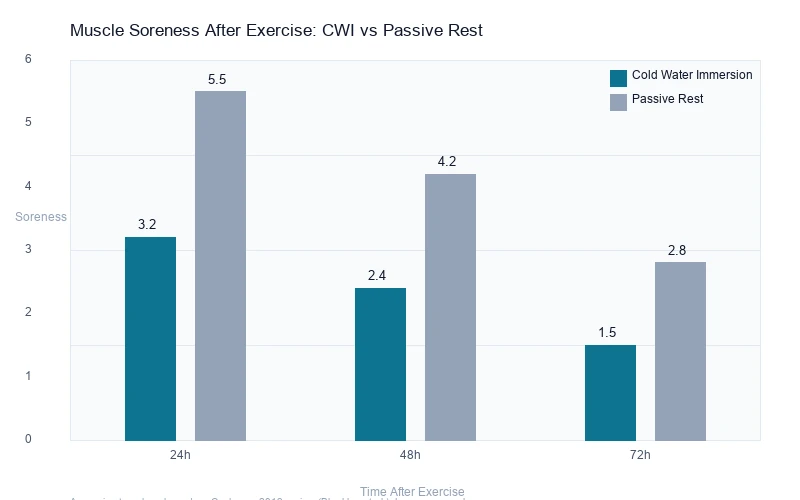
A Cochrane systematic review pooled 17 trials covering 366 people. Compared with doing nothing, cold-water immersion significantly reduced muscle soreness at 24, 48, 72 and even 96 hours afterwards — a consistent, real effect.
The honest caveats matter just as much: the review rated the studies as low quality, and when cold water was compared against warm-water or contrast baths, there was no clear winner. In other words, the cold itself may be doing less than the simple act of immersing and resting.[1]
When it's worth doing
If you train or compete again within a day or two and just need to feel less beaten up, a short plunge is a reasonable, low-cost tool. Just don't expect it to repair tissue faster — and remember it can blunt strength adaptations if you lifted heavy, so save it for the days that aren't about building muscle.[2]
A sensible recovery starting point
| Goal | Cold plunge? | Note |
|---|---|---|
| Ease DOMS before next session | Reasonable | 5–10 min, 10–15°C |
| Recover for a same-week race | Helpful | Within a day |
| Maximise muscle growth | Skip right after lifting | Use rest days instead |
| Just relax and de-stress | Fine | Any time you like |
Common mistakes
- Believing colder and longer recovers you faster — the soreness benefit plateaus quickly and the extra cold only adds risk.
- Skipping a warm bath because it's 'not hardcore' — the review suggests it may help soreness just as much.
- Using a plunge to paper over too little sleep or protein, which do the real recovery work.
Set a safe recovery time
Get a sensible duration for your water temperature, then keep your weekly total in a healthy range with the tracker.
Open the calculatorCommon questions
Does cold water actually speed up muscle recovery?
It reliably reduces how sore you feel for several days after exercise, but the evidence that it physically repairs muscle faster than rest is weak. Think of it as comfort, not a repair accelerator.
Is a cold plunge better than a warm bath for recovery?
Not clearly. In the Cochrane review, cold-water immersion showed no decisive advantage over warm-water or contrast baths for soreness. Use whichever you'll actually do consistently.
How cold and how long for recovery?
A few minutes in roughly 10–15°C water is plenty. Going colder or longer adds cold-shock risk without adding recovery benefit. Use the calculator for a safe range.
Will recovery plunges hurt my gym progress?
Only if you plunge right after heavy strength training, which can blunt muscle and strength gains. On endurance or rest days, recovery plunges are a much smaller trade-off.